[Note: connectivism principles are highlighted in italics.]
I described the main topics in my Digital Literacies subject in the post for activity 8. In common with other instructors I would provide a set of 'prime' sources for each topic, deliberately limiting them in number. For each topic, essentially one facet of network and computer technology, I would take a definitive stance on the effectiveness of that technology - I would state an opinion. Students would be invited to pose different opinions to encourage a diversity of opinions.
Students would need to search and discover additional resources to support these opinions and be shown how to connect all resource links using shared repository tools such as Mendeley. This would introduce the process of connecting specialised nodes of information sources. As per my comment on activity 17 I would develop with class input a series of significance measures to judge the quality of the resource links (nodes) developed for the information sources. These measures would include currency and a determination if the resource is more critical than what is currently known. Much guidance on the authority of authors and the place of blogs, tweets and other social media status updates needs to be given and a set of guidelines established that evolve as the course progresses.
Most of the aspects of modern digital literacies are strongly interlinked and assessments for the students would encourage them in their ability to see connections between literacies. The course would strongly suggest that they continually evolve this refinement of the connection mechanism to nurture and maintain connections to facilitate their continual learning beyond the end of the course. Indeed this should become a habit for the remainder of their lives.
29 April 2013

25 April 2013
Activity 16 Examining a definition of Personal Learning Network #h817open
I define a personal learning network, PLN, as:
My first disagreement with the Wikipedia definition of PLN is that I regard my own PLN as both formal and informal. Over the last 8 years or so with blogging, Facebook and then Twitter my PLN was been used largely for professional purposes where information provided to me or elicited by question has been used for learning to better at my profession - university teaching. In turn I have responded in kind with all the people in my PLN.
Certainly the composition of the people in my PLN is informal and can change on a regular basis as my professional and personal interests change. Social media apps make the maintenance of the people group straightforward.
Much of the literature tends to emphasise the communication technologies and tools used to create and maintain a PLN. Diagrams like those on the left list huge lists of web sites and cloud apps, in other words the tools that can be used to communicate synchronously and asynchronously with people in your PLN usually social networks of some kind. Other apps are included that provide the personal publishing mechanisms that allow each person to be creative and easily share their work with others.
These tools are vital of course to the operation of you PLN in my view are not the main focus of how your PLN facilitates you learning. Of necessity many of the tools come and go over sometimes very short period of months or a year or two. It is therefore vital for each individual to use a variety of tools and test them on the basis of how many useful people employ the same tool and hence can join your PLN. Trying out new tools should become second nature but only continue with a new tool if the community it supports yields benefits and the tool itself is compatible with the usual set of tools.
Of primary importance always is the people network that is at the heart of your PLN. If your tools provide a connected network report it should be used regularly to check the effectiveness and reach of your PLN. It is the people and the links to their artifacts that form the core of your learning.
Usually the amount of information generated by your PLN is excessive and a strategy for winnowing out the gems is needed with the help of yet more curation tools, another category of tool that must be investigated.
A loose but evolving collection of people connected by cloud apps on the Internet and whose views and information on topics of interest to me, both personal and professional, I find are of benefit to my daily activities, in other words my continual lifelong learning.
My first disagreement with the Wikipedia definition of PLN is that I regard my own PLN as both formal and informal. Over the last 8 years or so with blogging, Facebook and then Twitter my PLN was been used largely for professional purposes where information provided to me or elicited by question has been used for learning to better at my profession - university teaching. In turn I have responded in kind with all the people in my PLN.
Certainly the composition of the people in my PLN is informal and can change on a regular basis as my professional and personal interests change. Social media apps make the maintenance of the people group straightforward.
 |
| From Education Technology Guy educationaltechnologyguy.blogspot.com |
These tools are vital of course to the operation of you PLN in my view are not the main focus of how your PLN facilitates you learning. Of necessity many of the tools come and go over sometimes very short period of months or a year or two. It is therefore vital for each individual to use a variety of tools and test them on the basis of how many useful people employ the same tool and hence can join your PLN. Trying out new tools should become second nature but only continue with a new tool if the community it supports yields benefits and the tool itself is compatible with the usual set of tools.
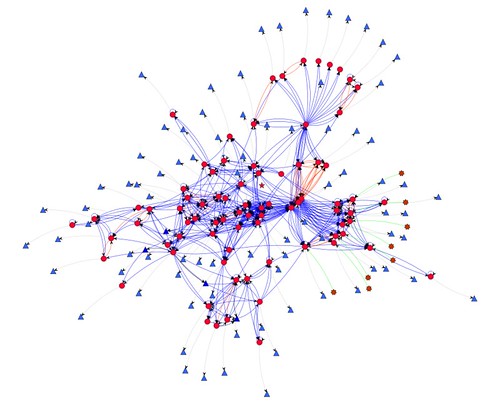 |
| From Kegg Apoptosis http://www.flickr.com/photos/sjcockell/ |
Usually the amount of information generated by your PLN is excessive and a strategy for winnowing out the gems is needed with the help of yet more curation tools, another category of tool that must be investigated.
Activity 14 Comparing MOOCs #h817open
I chose to compare Change MOOC with Udacity CS253 Web Apps Engineering (now called Web Development), a course I completed and received a high grade.
Technology
| Udacity CS253 | Change MOOC |
|---|---|
| As might be expected Udacity has invested in a propriety MOOC platform designed to meet its early courses which are mainly in the STEM disciplines. The MOOC platform is centred around a sequence of lessons each consisting of a series of many short videos (about 20) which are a mix of talking heads, an electronic handwritten whiteboard with narration, in-video quizzes along with instructor notes when needed. The critical ability to navigate between videos and quizzes has steadily improved over time from the crude next/previous links of the early courses. Within a lesson the student can quickly move to any video/quiz component with a simple click. A course wiki contains lecture notes and associated written material and links to other material. The primary interaction locus for student is the forum. 12 months ago this was a fairly standard forum, but it is good to see that a useful structure based around the units and the problem sets not applies. Essentially this is structured hashtagging that allows easy searching for discussions around the main course components. Of course the main communication timeline from instructors to students is via email. | From the course outline we find participants will use a variety of technologies, for example, blogs, Second Life, RSS Readers, UStream, etc. Course resources will be provided using gRSShopper and online seminars delivered using Elluminate. In other words the participants choose from a wide range of publicly accessible shared communication tools. Some like Second Life and Elluminate was highly interactive at scale and allow frequent and personal interactions between participants. Elluminate is most effective when used in realtime and offers a way to access an instructor directly. A real benefit here is that each participant can choose the set of tools with which they are familiar thus substantially reducing the technological friction allowing more time for interaction on the course. |
Pedagogy
| Udacity CS253 | Change MOOC |
|---|---|
| A basic sage on the stage pedagogy is used with the videos/wiki providing the main content delivered from the sage. The MOOC platform guides the student through the linear lesson plan with automatically assessed quizzes and problem sets along the way. A simple but impressive web-based integrated coding environment is used for some quizzes and scripts provide immediate feedback. Assessments use the third-party Google App Engine and automated scripts provide feedback if their are problems and the final passing grade when appropriate. There is some instructor video feedback for common questions and problems determined from forum posts. Some key forum posts receive direct feedback from the instructor or teaching assistants. Otherwise peer discussion goes on via the structured forum and provides ad hoc peer interaction. Some natural student groups form in external social media such as Twitter, Google+ and Facebook. |
Being a course spread over 36 weeks with over 30 invited speakers it is difficult to compare with a 7-week xMOOC. The range of speakers and topics was hugely impressive and covered all leading-edge work in instructional technology. Probably most participants would choose the topics of direct relevance leading to highly personalised learning. The highly relevant daily newsletter created with significant effort by the course facilitators contains a topic and relevant recent blog posts and tweets from participants - together these form a large course archive for use beyond the course. From his keynote at THETA13 The Higher Education Technical Agenda conference in Hobart Alec Couros gave a very succinct description of the pedagogy on cMOOCs:  |
General approach and philosophy
| Udacity CS253 | Change MOOC |
|---|---|
| This was a practical course with well-prepared, very short videos which could be consulted and repeated easily as often as necessary. I found the forums useful to help solve problems particularly with the practical work. Even though I had taught a very similar course myself I learned a considerable amount. For students in control of a study discipline and a willingness to consult their peers when running into problems this traditional approach is highly effective. Student with insufficient background will drop out having received an appreciation of the required standard and been given the opportunity to repeat at a later time. |
Those participants who make it through the course not only receive a thorough understanding of the current state of ed tech they have effectively built a personal learning network. The latter will encompass a wide range of creative skills using publicly accessible cloud apps together with the momentum to continue to interact with the cohort of active course participants. They will have absorbed the philosophy for their own course of providing just a skeleton course structure and have the students fill out the content most relevant to them. |
22 April 2013
Avoid getting hooked on the concept of the virtual MOOC University
In this article about grading the MOOC university A J Jacobs makes the mistake of following the hype of the MOOC providers that claim this is the future of higher ed as we know it. This misses the point that MOOCs are a different, alternative paradigm that will evolve to become the way to acquire the skills and competencies needed for paid work, self employment and day-to-day living in general.
Even AJ acknowledges:
MOOCs provided me with the thrill of relatively painless self-improvement and an easy introduction to heady topicsStarting from a suitably early age why would a person ever need hugely expensive, increasingly overrated higher ed which less than 1% of the world's population can afford?
21 April 2013
Activity 12 Background to MOOCs #h817open
It is good to look back at the history of MOOCs and the influences and context that brought them forth. Martin's interview with George and Dave gives an excellent sense of the pedagogical challenges that were taken on and solved to a large extent in the early cMOOCs and are still confronting the xMOOCs today.
The lengthy report by McAuley et al being written 3 years ago and predating xMOOCs seems like ancient history and almost 2 MOOC generations old. Even Martin's MOOCs Inc post with the important link to Curt's May 2012 massive link bait seems to exhibit peeling MOOC paint. Curt admits that even back then he had too much reading, watching and listening to do to catch up on MOOC developments. So how much harder is it today?
 The last subject I taught at my own institution before retiring was entitled Web Applications. Subsequently the first MOOC I took as a student was Udacity's CS253 Web Apps Engineering now called Web Development. So can a MOOC compete with a traditionally lectured subject? You bet it can. In 7 weeks of the CS253 MOOC Steve Huffman and 1 TA covered about double the amount of material of my 12 weeks of lectures.
As it happens we both used Google App Engine for the practical work and this allowed direct comparison. I taught about 15 students and Steve at least 1,000 times that number. What I found most impressive was how App Engine allowed the used of automated assessment scripts so that students were able to receive direct and useful feedback with comments on their practical work 24/7. To moocify my own course would be very straightforward.
The drawbacks would be that my institution markets and prides itself on small class face-to-face teaching. Also I believe most of the weaker students would struggle after about 3 weeks of the MOOC pace, probably explaining the high dropout rates from which most MOOCs experience.
As far as I know the furthest my previous colleagues have come is to put up course lectures and special presentations on iTunesU, where I have to admit they receive acceptable viewing rates. A noticeable trend is that the shorter the 'lecture' the higher the viewing figures.
The lengthy report by McAuley et al being written 3 years ago and predating xMOOCs seems like ancient history and almost 2 MOOC generations old. Even Martin's MOOCs Inc post with the important link to Curt's May 2012 massive link bait seems to exhibit peeling MOOC paint. Curt admits that even back then he had too much reading, watching and listening to do to catch up on MOOC developments. So how much harder is it today?
As it happens we both used Google App Engine for the practical work and this allowed direct comparison. I taught about 15 students and Steve at least 1,000 times that number. What I found most impressive was how App Engine allowed the used of automated assessment scripts so that students were able to receive direct and useful feedback with comments on their practical work 24/7. To moocify my own course would be very straightforward.
The drawbacks would be that my institution markets and prides itself on small class face-to-face teaching. Also I believe most of the weaker students would struggle after about 3 weeks of the MOOC pace, probably explaining the high dropout rates from which most MOOCs experience.
As far as I know the furthest my previous colleagues have come is to put up course lectures and special presentations on iTunesU, where I have to admit they receive acceptable viewing rates. A noticeable trend is that the shorter the 'lecture' the higher the viewing figures.
13 April 2013
Activity 11 Pros & Cons of big & little OER #h817open
In a couple of my previous posts for this MOOC specifically on location OERs for a digital literacies course and OER issues I have complained of various difficulties with what our instructor is calling Big OER. These difficulties mainly relate to searching and discovery, reusability and pertinent for this activity the granularity of OER. Long lectures peppered with irrelevancies and voluminous course notes carrying unwanted side issues are the main problems. Reuse of these Big OERs therefore mitigates against reuse without substantial remixing involving the same level of work by the instructor as starting from scratch.
 Taking Martin's Collateral Damage slidecast as the queue I find I have always been in sympathy with the view that it is the collection of simple digital artifacts easily made widely available online that form the most useful educational material for my own courses. As Martin points out these artifacts are easily produced with simple online publishing services many of which are free, and, most importantly, don't require specialist broadcasting skills beyond those possessed by the typical lecturer. Most usefully too is these Little artifiacts tend to be byproducts of normal academic activities producing outputs like papers, code, lectures, recorded debates, conference talks, data, ideas, and workshop materials.
I like the thought of this long tail of academic outputs, often produced out of research activities, finding immediate use in teaching. At last we have a demonstrated direct link between research and teaching. This needs further emphasis to encourage many of the reporting and administrative activities to be made more visible and accessible online as part of the normal production process. The academic becomes a perfect long tail production engine. We owe a debt to Martin to giving this process an acceptable and impressive name - digital scholarship. These Little OERs also make impressive background materials for public engagement with world community, an increasingly important aspect for all academic endeavours.
Of course discovery of these Little OERs or digital artifacts still remains a problem. Maybe the universal adoption of hashtags in all online publishing platforms might be a step towards a solution provided the content is searchable by Google or more specialised search engines.
10 April 2013
Activity 10 Applying sustainability models #h817open
I consider a number of open education initiatives and after a brief look at their web sites attempt to determine which of the three funding models, MIT, USU and Rice, proposed by Wiley in his OECD report are being used.
- Change MOOC: the facilitators are the cMOOC kings who seemed to provide their time gratis with the apparent help of volunteers. Certainly the 30 or more speakers, one per week, provided their input freely and to great affect. It would seem that the Rice model is being used here.
- Coursera: set up as a private company but still offering free MOOCs prepared by a large consortium of high-profile universities around the world but with most being in the USA. Each MOOC is prepared professionally with the cost met by member institutions. The total team size of full-time equivalent staff is likely in the thousands. Coursera presents and operates as a single entity so I would put them in the MIT category.
- Jorum: funded by JISC (a UK charity) collects and shares learning and teaching materials allowing for reuse and repurposing. Although the materials served are free for reuse Jorum is supported by full-time professional staff so again is more akin to the MIT model. Since the OERs in the Jorum repository are obviously provided by a wide range of 'volunteer' contributors across the globe it could be argued this is like the USU model as well.
- OpenLearn: operated entirely by the Open University UK to provide MOOCs to the world. This would seem to definitely conform to the MIT model.
From the chosen open education initiatives it would appear the MIT model carries much weight. Wiley's model categories seem a sensible spectrum but it is obvious elements from two of more of his models are mixed in practice.
Subscribe to:
Posts (Atom)